Continuing through December 19, 2026
When Simon Evans showed at the Jack Hanley Gallery from 2003 to 2005 he was making memorable drawings augmented by hand-written, thin strips of text glued onto drawing paper. These were strikingly incisive and funny diaristic musings. An expat British skater turned artist, he lived in a neighborhood reeling from the success of the Mission School. Those works mirrored the do-it-yourself ethos of the moment, often employing found and distressed plywood and cardboard to collage together paintings with text.
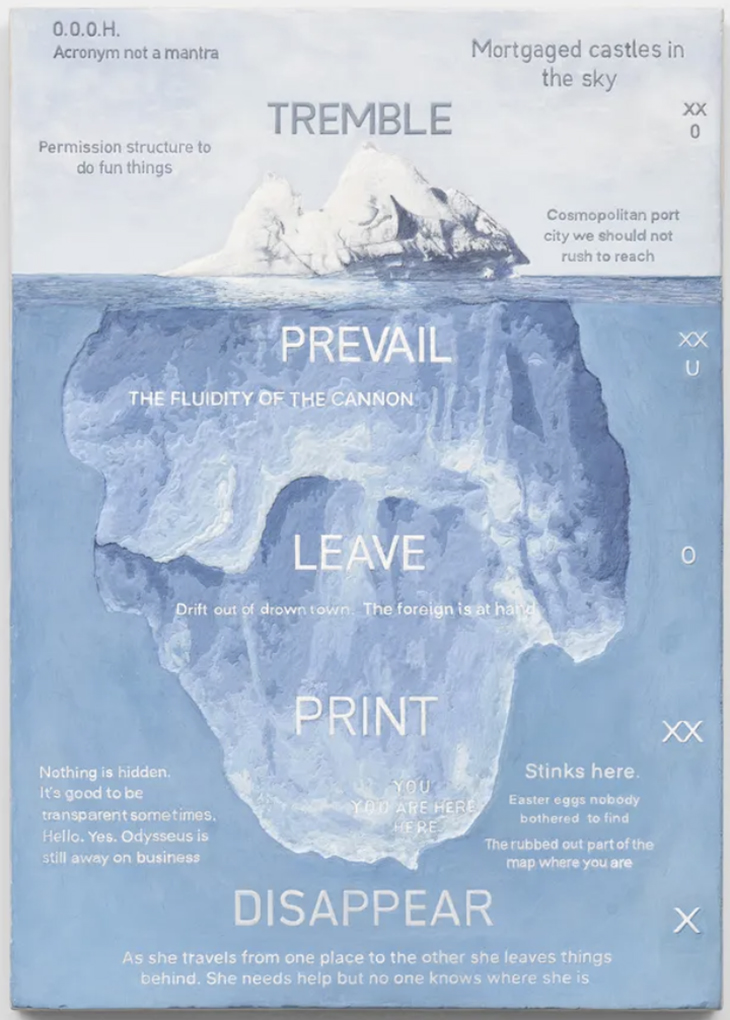
He returns after an absence of some two decades, showing works done in collaboration with his partner Sarah Lannan with whom he now lives in Brooklyn. The exhibition title, “Never Better Than Later,” a reference to the homecoming nature of the exhibition, pops up in a few works, most notably on an entryway floor mat. A mixed media work on wood, “Iceberg” (2024) is a munificent tribute to their feelings for San Francisco. Like the proverbial iceberg, for them most of the city’s true nature is hidden beneath the waves, only its most obvious aspects readily available to the casual visitor.
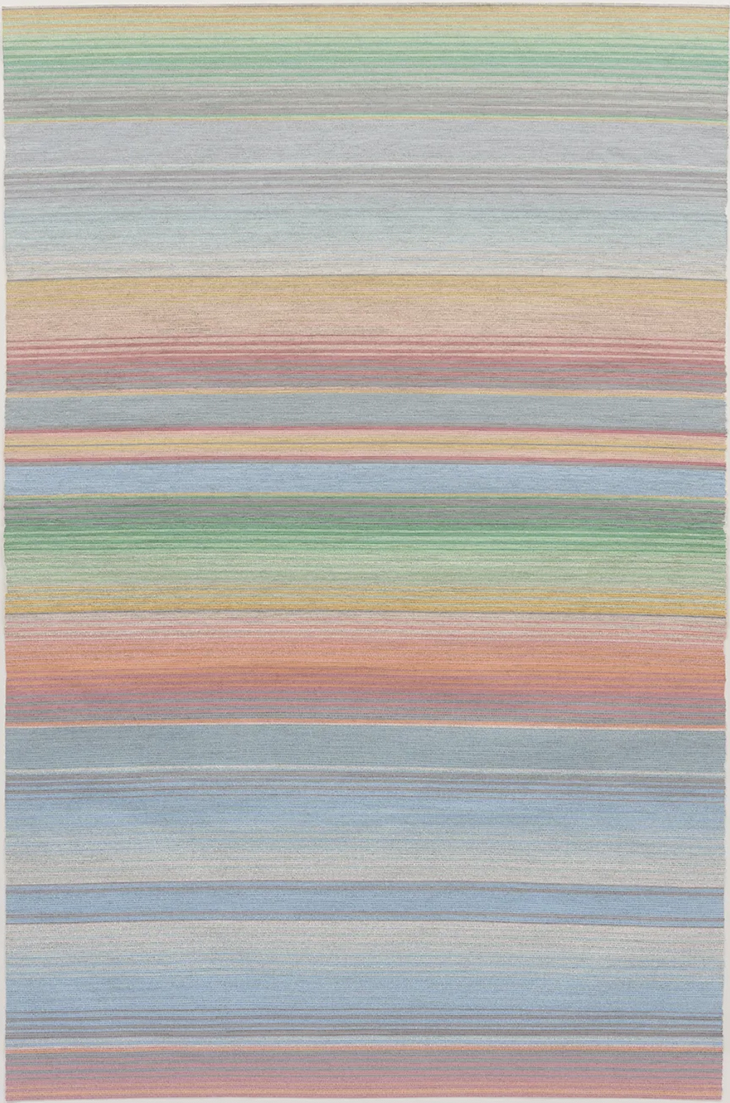
The core of their project remains essentially unchanged from the work seen two decades ago, though the use of language is more thoroughly immersed in a visual context than it was in the past. In fact, in a work such as “Mexican Blanket Diaries” (2026), it’s initially possible to perceive only a series of colorful horizontal lines. Only on close inspection — really, get your nose just a few inches from the drawing — does the text reveal itself embedded in black pen amid each color stroke. It comes as a surprise to see that the blanket’s green, yellow or blue stripes suddenly reveal the dense writing within. It’s entirely handwritten in capital letters that scroll by like the Times Square news ticker, one idea blending into the next, including personal reflections, family interactions, references to reading, political rage, and an enormous range of similarly addictive storytelling: “1:24 AM 8 SEPTEMBER THE EPHEMERALITY OF LIFE AND THE PERSISTENCE OF YEARNING DUH MUSIC HOLDS IT ALL TOGETH…”
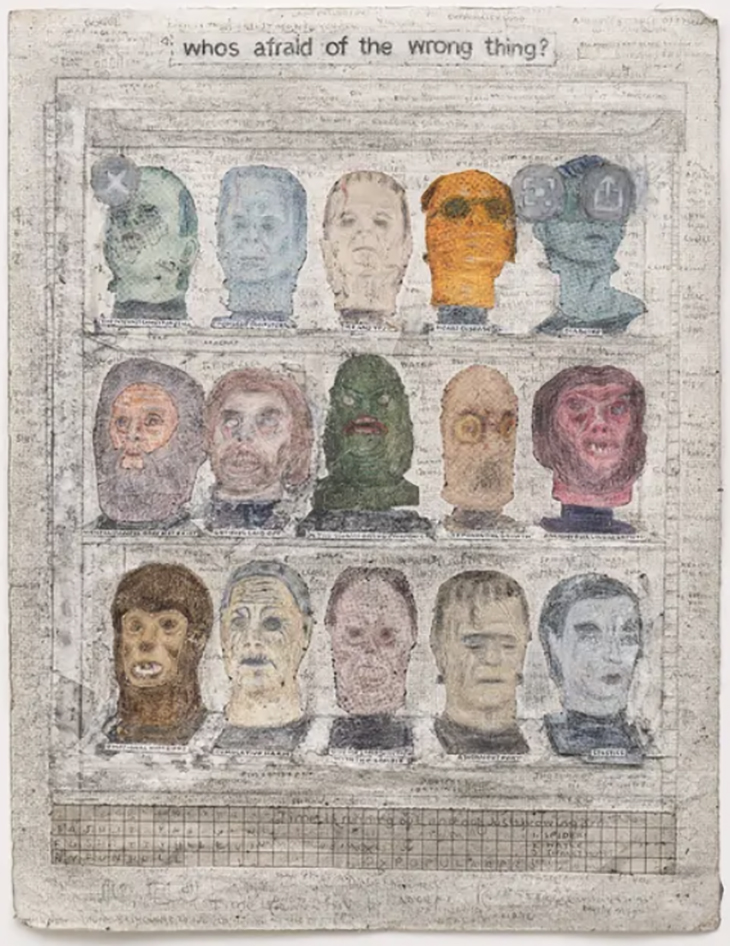
Their image/text project is most compelling when the visual elements and the writing achieve a sure handed, mutually reinforcing equilibrium. An example from 2001, “who’s afraid of the wrong thing?,” is a small, collaged drawing of fifteen masks from 1930s Hollywood monster movies. Roughly colored, they are surrounded by busy marks above a set of small boxes in pencil. It’s slight, almost a throwaway, yet completely succeeds as a complete if ineffable thought. Two larger pieces accomplish the same trick, but on a much more impressive scale: they steal the show and are difficult to stop looking at (or reading). “Hearts” (2026) is mostly white space, interrupted by over one hundred different tiny red heart-shaped images beneath which are caption-like phrases or sentence fragments. Two swans whose necks form a heart sit above the words “NOAH’S ART MUSEUM/TELLING THE HISTORY OF THE WORLD/WITH THE ANIMALS HE’S GOT.”
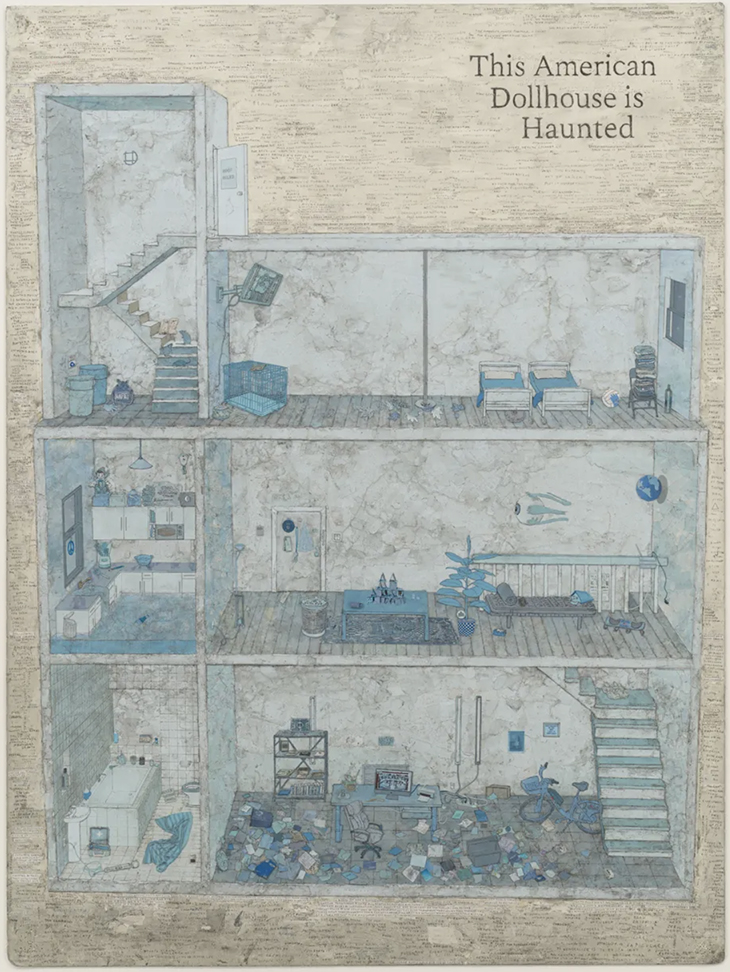
“This American Dollhouse is Haunted” (2022) depicts a cutaway diorama of a three-story house made up of one small room (entryway, kitchen, bathroom) and one large room (bedroom, living room, basement) on each floor. It’s rendered in a pale blue that augments a basic beige background, referencing blueprints. It’s spookily empty, no people pictured, and the house is a shabby mess. Books litter the floor of the basement office as though tossed by a poltergeist. The textual aspect of the drawing is limited to exterior walls, which make their observations suggestive of a graffiti-like commentary on political rage and the poverty brought on by government decisions. It’s also much more, touching on the nature of domesticity, architecture and the meaning of home. “A ZOOM OF ONE’S OWN” stands out among the wall writing as a comic subtitle.
The artists tap into the cinematic pleasure of cautiously stepping through a scary, abandoned house-as-metaphor for the polity, while the walls echo with the thoughts of former occupants whose disappearance is left unexplained. “Never Better Than Later” reminds us that when we move from a home, or leave a city, the lives we leave behind become a haunted presence we revisit only through highly subjective and selective memory. The walls speak, “TEXT MESSAGES ARE GHOSTS/THE REAL WORLD IS A DOLL HOUSE FORGOTTEN ABOUT…”