
Continuing through May 30, 2027
Time and distance are elastic in the work of Dewey Crumpler. Objects migrate across centuries, continents, and cultures, pointedly shedding familiar identities while acquiring new meanings. A hooded sweatshirt becomes a tulip, a cowrie shell, a vessel, or a portal into another dimension. Shipping containers, the ubiquitous instruments of global commerce, become reminders of the transatlantic slave trade. Forms stretch, collapse, multiply, and reappear, carrying histories that refuse to disappear.
Crumpler does not simply use abstraction to express Black experience. He proposes that African diasporic history and consciousness offer another way of understanding space, time, and visual form. His art refuses to separate aesthetic freedom from historical responsibility, insisting that abstraction can be formal, philosophical, and political all at once. Crumpler does not abandon history by embracing abstraction. Rather, he finds subtler means of investigating it.
“Sonic Lineages” fills three floors with work spanning more than five decades, from the late 1960s to the present. Organized by Key Jo Lee, it is Crumpler’s first institutional solo exhibition in San Francisco, his hometown. He began as a muralist, painting public walls across the city in the 1970s and 1980s; many of them have survived the intervening decades. Having mentored students including Kehinde Wiley, Deborah Roberts, and Rozeal during his years teaching at the San Francisco Art Institute, few Bay Area artists have shaped so many careers while waiting so long for a survey of their own.
The exhibition unfolds less like a conventional retrospective than like a musical composition. Motifs recur, sometimes barely recognizable, moving between painting, sculpture, kinetic constructions, and neon. Like jazz, Crumpler’s work depends on the tension between structure and improvisation, the familiar and the unexpected. It is also an art born of hardship but not defined by it.
“My work has always been interested in history, history never really leaves,” Crumpler remarks in the PBS documentary about him, “Post Atlantic.” “Those containers, those ships reminded me of how bodies and goods were transported to fuel the economy. We’re right back there, again.”
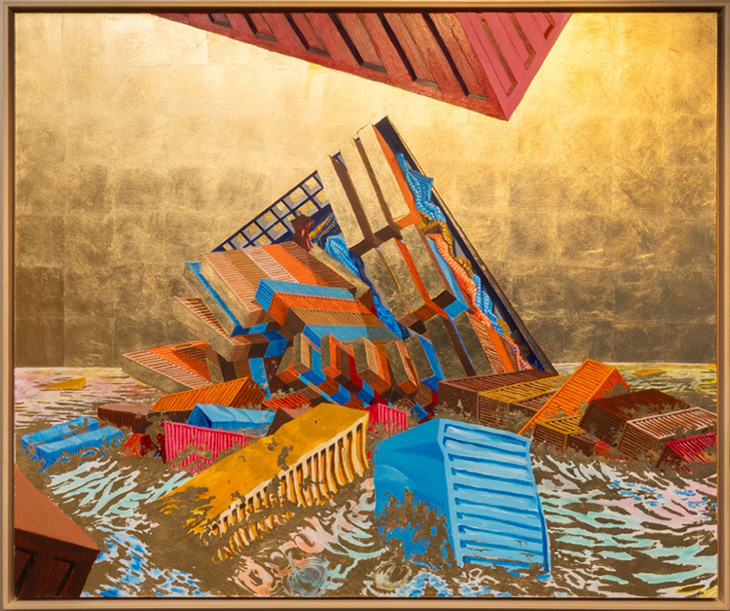
This entanglement of history and commerce is most apparent in “Collapse” (2011), a large acrylic painting of shipping containers and the fractured hull of a cargo vessel rising from, or sinking into, a turbulent sea. Against a luminous golden sky, brightly colored geometric forms tilt and collide, while the water below churns with calligraphic marks and fragments resembling partially formed words. The scene reeks of catastrophe, yet its shimmering surfaces and exuberant color summon the sublime, where terror and beauty meet. The containers, once orderly units of international trade, here tumble into wreckage. Their repetitive forms allude to the reduction of human beings to cargo. Rather than illustrate that violence, Crumpler embeds it within the familiar architecture of the global economy.
The recurring hooded sweatshirt motif began more than thirty years ago when Crumpler noticed his son’s hoodie draped over a chair. Emptied of its wearer, it becomes a strangely self-animating presence, at once a body and its absence. Often rendered in gray, its drooping contours suggest a living form, but it is a figure without a face, identity, or fixed location. After the killing of Trayvon Martin in 2012, the garment acquired a public significance that these apparitions seem to have anticipated. They move through time and space as specters on the horizon, suspended between physical and spiritual worlds.
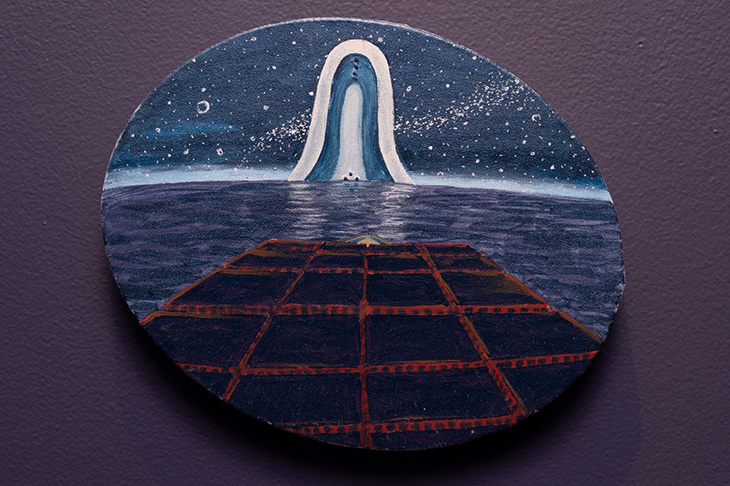
The hoodie form in Crumpler’s hands is remarkably mutable. Squeezed, elongated, inverted, and multiplied, it can resemble a tulip, an anatomical structure, or even Marcel Duchamp’s “Fountain,” that most notorious of transformed objects. In the seascape “Twilight #3” (2020), a towering hooded shape rises above the horizon like an alien monument, unsettling the calm of the landscape.
In the “Void Series” (1999) Crumpler strips these forms of recognizable associations to explore their formal possibilities. Against fields of saturated color, narrow openings bend and branch. Some suggest body cavities or cellular structures; others could be wormholes into the unknown. The voids are not empty. They are thresholds through which one form, one state of being, might be transformed.
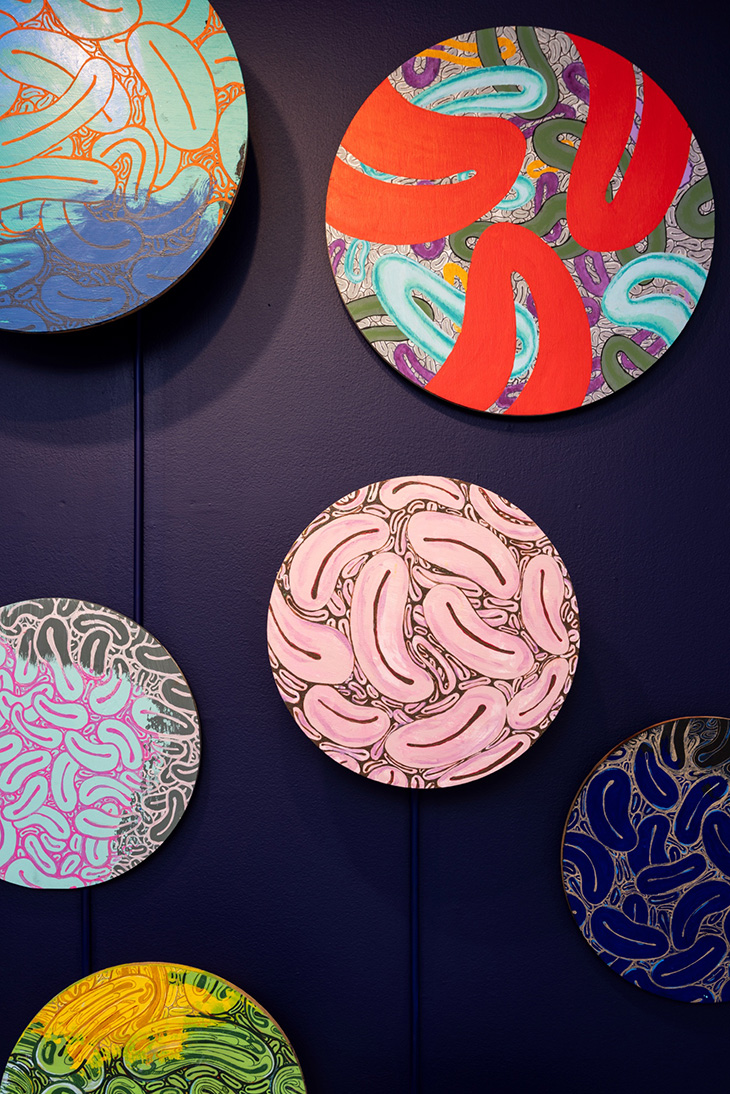
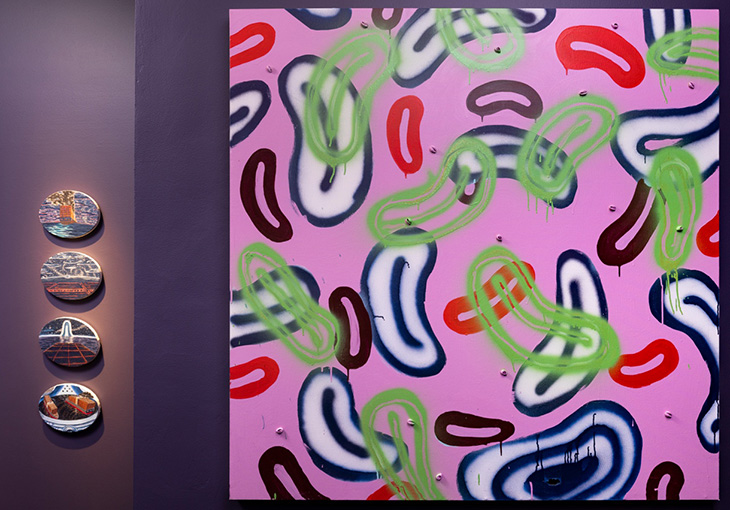
“Swimming Pink” (2023) turns these metamorphoses toward pleasure. Against a hot pink ground, biomorphic shapes in green, red, blue, and black drift and overlap. Some resemble cells seen under a microscope; others suggest cowrie shells, historically used as currency in many parts of Africa. Actual cowrie shells are at times embedded in the painting’s surface. Shapes and shells alike float freely, but their link to exchange value ties them to the darker economic history running through Crumpler’s work. Given that, the paintings’ sheer visual pleasure is not incidental. Crumpler’s exuberant palette and dancing forms assert Black joy as a force equal to Black history. Joy here is not an escape from the past. It is one of the ways the past is overcome.
On one brilliant blue wall, a salon-style hanging gathers paintings of different sizes and periods, letting motifs migrate from canvas to canvas. A form that appears figurative in one work becomes an abstract flourish in the next. Circular compositions read as miniature worlds, while larger canvases open onto landscapes, interiors, and imaginary spaces. Rather than imposing a linear progression, this presentation invites the eye to move back and forth across decades.
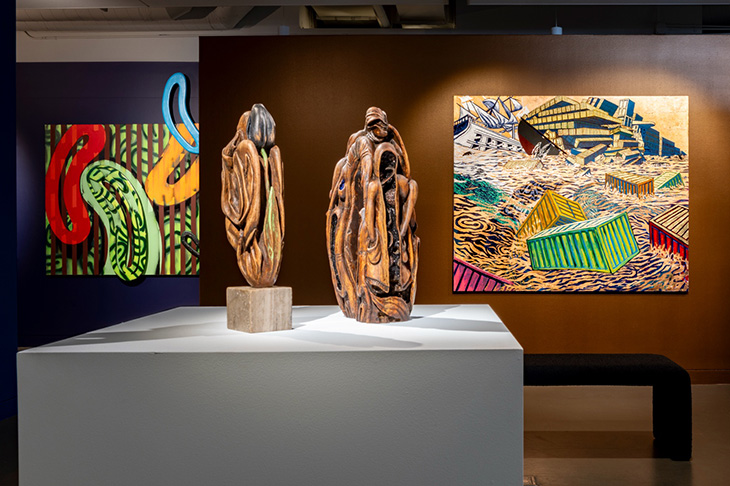
Crumpler extends this vocabulary into three dimensions with “Quantum #1” and “Quantum #3” (both 2026), small wooden sculptures whose hooded forms twist into cavities and folds. Embedded with glitter and enamel, their surfaces catch the light as we circle them. Installed in front of “Breach” (2023), with its energetic collision of shipping containers, a slave ship, and churning water, the sculptures set up a dialogue between the bodily and the architectural, the intimate and the monumental.
In the adjacent Bates Gallery, implied movement becomes literal. Crumpler’s recent kinetic works rotate at different speeds, their shifting relationships evoking musical rhythms. Individual elements move independently while contributing to the larger composition formed by the installation. What the static paintings imply through repetition and variation unfolds here in real time.
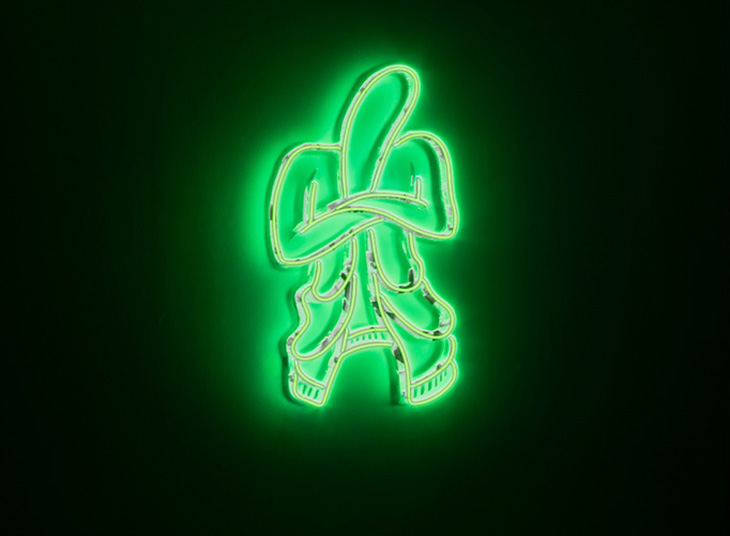
The most distilled expression of Crumpler’s concerns is “On and Off, Presence and Absence” (2026), a neon work on birch plywood commissioned for the exhibition. The familiar hooded form has been reduced to an illuminated outline. No longer a painted surface or sculptural object, it exists as light. Its electric green glow spills beyond the figure’s contours, across the wall and into the room, unrestrained by its own boundaries, hovering between materiality and dissolution.
“On and Off” serves as a fitting metaphor for Crumpler’s larger ambitions. Throughout “Sonic Lineages,” forms refuse to remain fixed, just as histories resist confinement to the past. Objects carry the memory of their origins even as they assume new identities. The hoodie becomes a vessel, the vessel becomes a void, and the void becomes light.
