
“Weights and Measures” has a sinuous genealogy. This expansive exhibition of Sahar Khoury’s recent sculpture displays a rich lineage of contemporary and historical art forms, cultural traditions, and philosophical inquiry. Developed from two Arts/Industry residencies at the John Michael Kohler Art Center, Khoury’s multifaceted production embraces video projection, ceramic and metal casting. Her eclectic sourcing and scavenging brings together such disparate elements as modern Mediterranean geo-political history, contemporary music collaborations and bread making tradiitions to yield surprising speculations on time and contingent meaning.
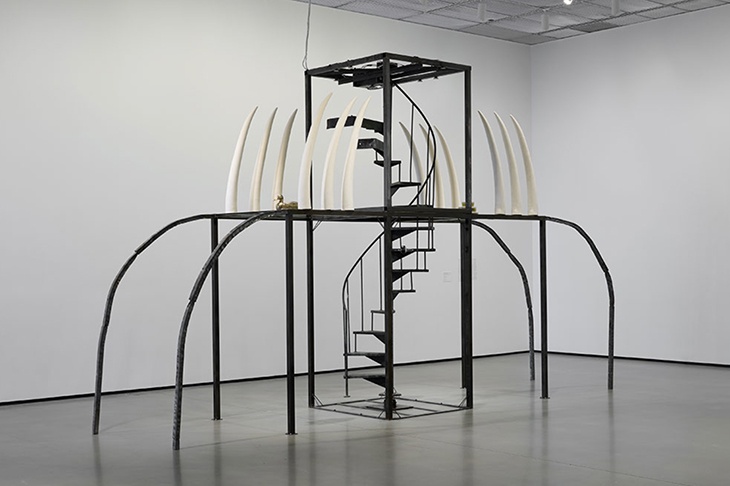
Organized by the museum’s Associate Curator Susie Kantor, the exhibition opens with a lean, somewhat icy constellation of works having eerily futuristic overtones. “Untitled (the elephant in the room [the tower of silence]),” 2025, dominates its space. A leggy frame of welded steel, 12 feet high, brackets a two-story spiral steel staircase engineered to rotate at one revolution per minute. The frame also supports the glass platform for twelve trompe l’oeil cast porcelain elephant tusks, small jars of Palestinian olive oil stacked in a pyramid as if they were merchandise, and a ceramic depiction of the paperback “The Denial of Death,” a treatise by cultural anthropologist Ernest Becker on how societies view the inevitability of death.
The work’s skeletal, rectilinear frame evokes the desiccated ruins of a North African and/or Southwest Asian marketplace, and the staircase references the remains of a clocktower. To the extent that Khoury sets empty space against mass and volume, the work isn’t only about what is seen. As a metaphor, the spindly, angular apparatus models an ominous generative engine or hyperlink to the unseen. It’s as if this slightly macabre prototype manifests belief systems of the past and present, how societies make space for themselves and the beliefs and values that their culture may carry into the future.
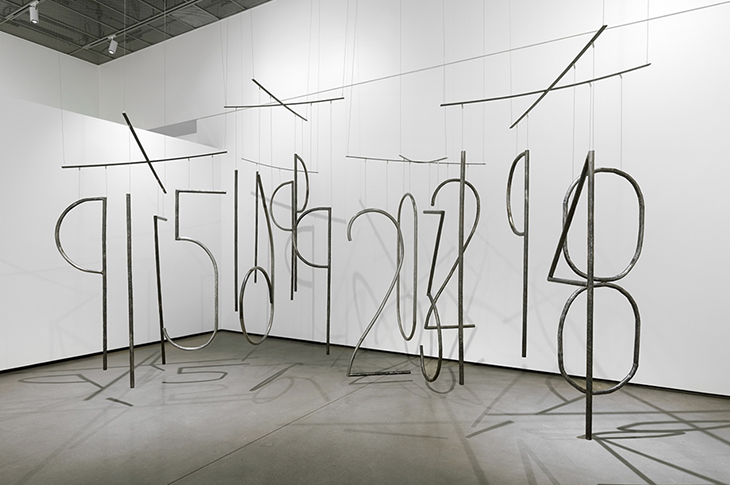
Khoury brings a trove of symbols, associative words, non-linear histories and fugitive trajectories to her works. Her forms are spare, often having the exaggerated proportions and contrasts of German Expressionist mise-en-scénes such as Fritz Lang’s “Metropolis” or Tim Burton’s gothic styled films. “Untitled (the puppet dates)” (2025) dangles an array of elongated forged steel numbers that at first sight appear to be a graphically linear abstraction floating in space. Depending on one’s line of sight, the numbers sway like puppets and reveal themselves to be dates of U.S. conflicts in Eastern Mediterranean nations. The work is a formally lyrical ensemble of geopolitical aggression and a visually deceptive mix ‘n’ match installation that subversively undermines any linear sense of time. The looming, larger-than-life shadows enhance the separation between reality and perception.
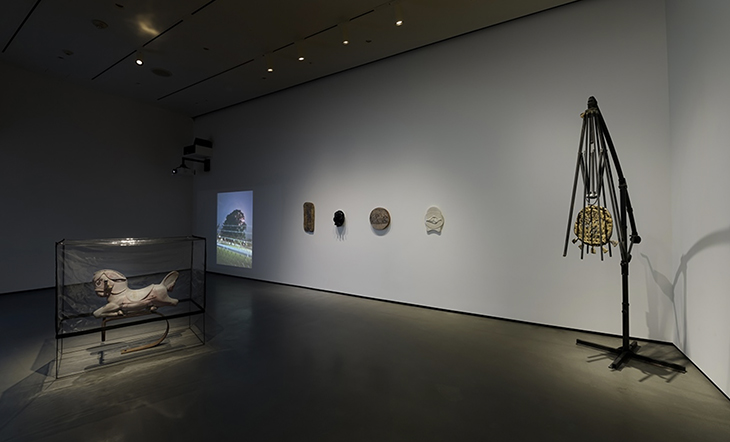
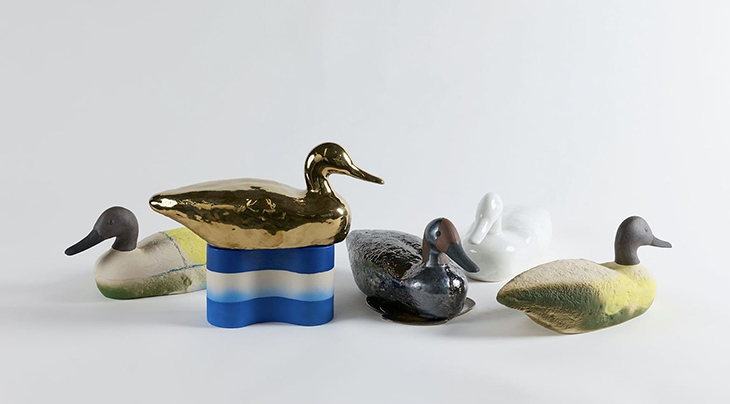
Assessing how history lingers in the present to identify what is valued and preserved versus what is discarded, Khoury recasts elements she retrieves from our disposable culture. The array of such things makes up an extensive list of what begin as banal objects: olive oil tins, briefcases, rusty hand tools, office equipment, collapsible dog crates, shopping bags, vegetables, suitcases, hat racks, produce scales, duck decoys, umbrella stands, and ready-for-roasting turkeys are enlisted to productively resuscitate the past and deliver newly invented forms.
“Untitled (the send off)” (2025) exemplifies Khoury’s narrative strategy. Blending the grave with the whimsical, a sinuous line of interlocking blocks of tile meanders the length of the seam where the floor meets the gallery wall. Like an infinitely slow River Styx, in blues ranging from deep indigo to almost a pure white, the tile ferries a succession of ceramic duck decoys housed in loosely woven reliquaries, cages or baskets, a ceramic turkey breast platter or candelabra, and casts of rolled up rugs that literally hit the wall. Leading this funereal procession, floating face up, flat on its back with a blanket covered up to its little billed chin and a candle on its chest, is a dead duck. The work is antithetical to the accustomed way that themes of mortality, time, and societal and familial rituals of life are presented. Khoury’s deadpan humor charges the work with unexpected warmth and tenderness.
